






The new casino: South Korea tries to save the KOSPI
A War on speculators instead of supporting the market
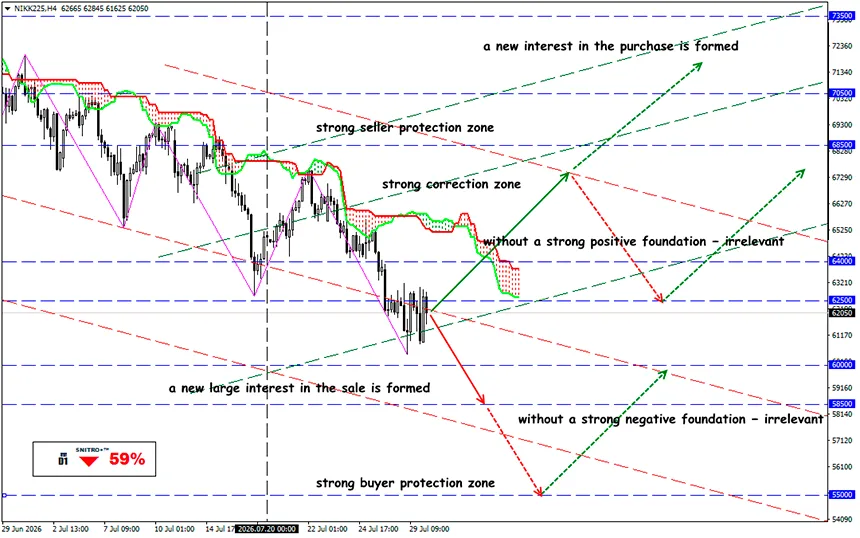
NIKK225
Key zone: 61,800 -63,500
Buy: 64,000 (on strong positive fundamentals); target 67,500; StopLoss 63,300
Sell: 61,300 (on a confident break above 61,500); target 58,500; StopLoss 62,000
South Korean authorities have chosen tighter regulation over direct support for the stock market. Following the sharp collapse of the KOSPI, an emergency F4 meeting attended by the finance minister, the governor of the Bank of Korea, and the heads of the country's financial regulators concluded without launching a large-scale market intervention. Instead, the government decided to restrict the investment products it believes amplified market instability — leveraged ETFs linked to individual stocks.
Let's recap:
The latest events have become one of the most severe shocks to the South Korean stock market in recent years.
- On July 28 and 29, the KOSPI index lost 16%, while the exchange was forced to activate its circuit breaker mechanism on both trading days.
- From its June peak, the index has fallen by approximately 40%.
- Additional pressure emerged after SK Hynix released its earnings report. Despite strong financial results, the company failed to meet investors' exceptionally high expectations, reinforcing doubts about continued growth in spending on artificial intelligence infrastructure.
- At the same time, concerns intensified over growing competition in the global memory semiconductor market.
- According to the authorities, the double-leveraged single-stock ETFs introduced in May became one of the factors that amplified the sell-off, although regulators acknowledge they were not the sole cause of the crisis.
At the same time, tensions among retail investors continue to rise. Following the sharp market decline, many investors with margin positions suffered substantial losses, while some brokerage clients even ended up owing money to their brokers. Discussions about filing collective claims to protect affected investors have already begun within the investment community.
Following the emergency meeting, regulators announced a package of restrictive measures.
- Retail investors' exposure to leveraged single-stock ETFs has been capped at 20% of their investment portfolios.
- Trading costs for these instruments will be increased in an effort to reduce speculative activity.
- Beginning July 31, a mandatory minimum deposit of 30 million won (approximately $20,600) will be required to trade such ETFs.
- The previously introduced ban on launching new leveraged single-stock ETFs and advertising existing products will remain in force.
- Financial regulators will move to round-the-clock market monitoring and have declared their readiness to introduce additional stabilization measures if necessary.
According to the government, there were no fundamental economic reasons for such a dramatic market collapse. Instead, the crisis developed as a result of several factors acting simultaneously:
- large-scale liquidation of positions triggered by margin calls;
- high concentration of retail investors in Samsung Electronics and SK Hynix through double- and triple-leveraged ETFs;
- investor disappointment following SK Hynix's earnings report, which was strong in absolute terms but failed to meet inflated market expectations;
- the ongoing global correction across the AI sector.
The political debate quickly expanded beyond the stock market itself. Lawmakers criticized the approval process for leveraged ETFs, arguing that warnings about potential risks had been ignored from the very beginning of these products' introduction.
Finance Minister Koo Yun-cheol publicly admitted that the government had underestimated the potential consequences of allowing such investment products onto the market. He apologized to investors and announced plans to establish a legislative framework for market stabilization mechanisms similar to those used in Hong Kong.
So, what is the outcome?
Most analysts believe the new restrictions could reduce speculative activity in the future.
However, the measures adopted do not resolve the key problems:
- they do not address the issue of leverage already accumulated in the market;
- they do not apply to similar foreign ETFs;
- they do not eliminate the primary reason behind the sell-off — declining investor appetite for overvalued AI companies.
In reality, the emergency meeting represents only the first stage of the authorities' response. The government has focused on reducing systemic risks and tightening regulation rather than directly supporting the stock market. In the short term, this is unlikely to ensure a rapid recovery of the KOSPI, but it does establish a new direction for government policy toward high-risk investment instruments.
So we act wisely and avoid unnecessary risks.
Profits to y’all!